
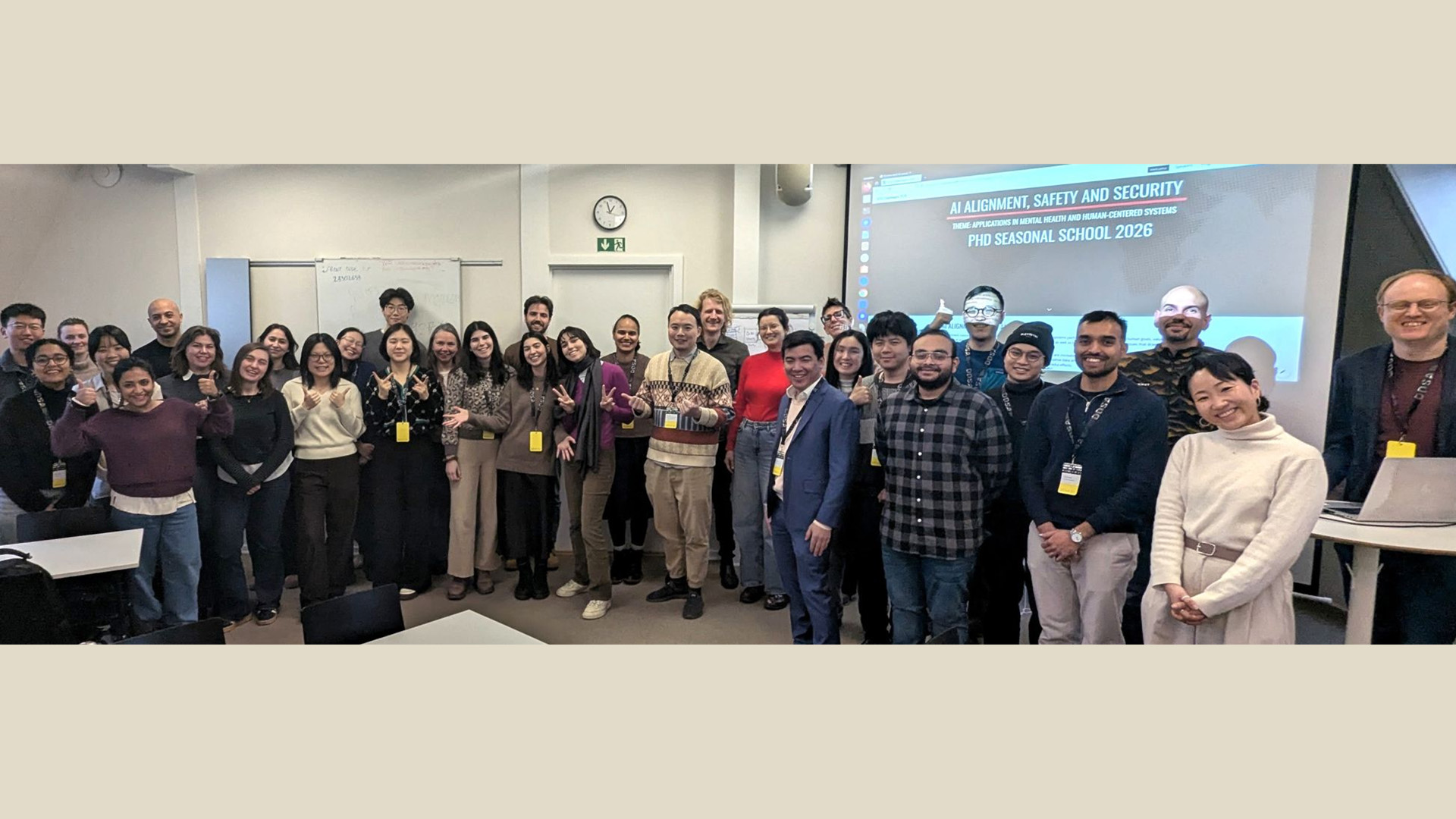
From 20 to 23 January 2026, the alignAI Doctoral Network held its second Seasonal School, “A2S2: AI Alignment, Safety, and Security: Applications in Mental Health and Human-Centered Systems”, in Frederiksberg/Copenhagen, Denmark. The four-day program was organised by the Technical University of Denmark (DTU), the University of Copenhagen, and the Capital Region of Denmark Psychiatric Hospital (Region H), with support from the Danish Data Science Academy. Officially registered at DTU as a 2.5 ECTS PhD course, the event brought together all 16 alignAI doctoral candidates, along with early-career researchers and professionals from academia, healthcare and industry.
Prof. Sneha Das from DTU led the A2S2 initiative, with Prof. Nicole Lønfeldt, from the University of Copenhagen and the Region H as cofacilitator. The organising team also included Prof. Line Clemmensen, and doctoral candidates Katerina Drakos and Eva Paraschou. A2S2 used mental health as a practical lens for AI alignment, equipping participants to address challenges beyond basic harm prevention. The programme emphasised developing AI systems that are context-aware, transparent and governed by appropriate standards.
Day 1: Clinical Applications and Student Engagement
The school opened with a welcome address highlighting the shared goals of DTU and Region H. Next, Associate Professor Nicolai Lund Ladegaard of Aarhus University delivered a keynote on the use of virtual simulated patients for clinical skills training in psychiatry. In the afternoon, an interactive poster session enabled the doctoral candidates to present their research, exchange ideas with peers and principal investigators, and identify areas for collaboration in upcoming group work.
Day 2: LLM Alignment and Sociotechnical Challenges
On Wednesday, the programme focused on the technical aspects of AI alignment. Assistant Professor Ilias Chalkidis of the University of Copenhagen led a session on explaining large language models (LLMs) post-training and the related sociotechnical challenges. Also of the University of Copenhagen, Assistant Professor Dora Kampis followed with a discussion on altercentric human cognition. The day combined intensive lectures with group work and concluded with a networking dinner at La Oficina in Frederiksberg, strengthening connections between engineering and regional healthcare participants.
Day 3: Safety, Explainability and Human-Centred AI
Thursday’s sessions addressed safety, trustworthiness and human judgment in AI. Assistant Professor Nirupam Gupta of the University of Copenhagen outlined methods for embedding safety through robust model training. Associate Professor Rune Nyrup of Aarhus University examined the sociotechnological implications of AI explainability. Dr. Camilla Funch Uhre of RegionH connected these technical tools to clinical well being, discussing how generative AI can support executive functions and mental health self-regulation. Assistant Professor Lau Lilleholt Harpviken of the University of Copenhagen concluded by emphasising the importance of human judgment in data-driven environments.
Day 4: Novel Methodologies and Collaborative Synthesis
The final day highlighted key research methods and their applications in healthcare. University of Copenhagen Associate Professor and Head of SODAS School Hjalmar Alexander Bang Carlsen introduced the “AI Interviewer”, a new approach for collecting large-scale qualitative data. Dr. Anne Dorothee Müller discussed Region H’s mental health priorities, noting that chatbots are helpful for mental well being. The day concluded with student group presentations on integrating DTU’s technical expertise with Region H’s healthcare needs, followed by a session outlining next steps for the A2S2 project.
Strong Marks from Participants
The Seasonal School received 27 evaluation responses, with most feedback being positive. Participants valued the mix of technical, social-scientific, philosophical, psychological and clinical perspectives. They noted the event was well-organised, featured high-quality speakers and offered strong networking opportunities. Suggestions for future events included sharing lecture materials earlier, incorporating more real-life case studies and providing more structured breakout discussions. This feedback will inform improvements for future alignAI training events.
What’s Next
A2S2 met the goals of the alignAI Doctoral Network by providing training, building skills and sharing knowledge. Participants gained practical tools to evaluate alignment, safety and trustworthiness in AI systems for mental health and human needs. The programme also strengthened connections with the research and clinical community in Copenhagen. This initiative establishes a strong foundation for future seasonal schools as the alignAI cohort develops value-aligned large language models (LLMs).