
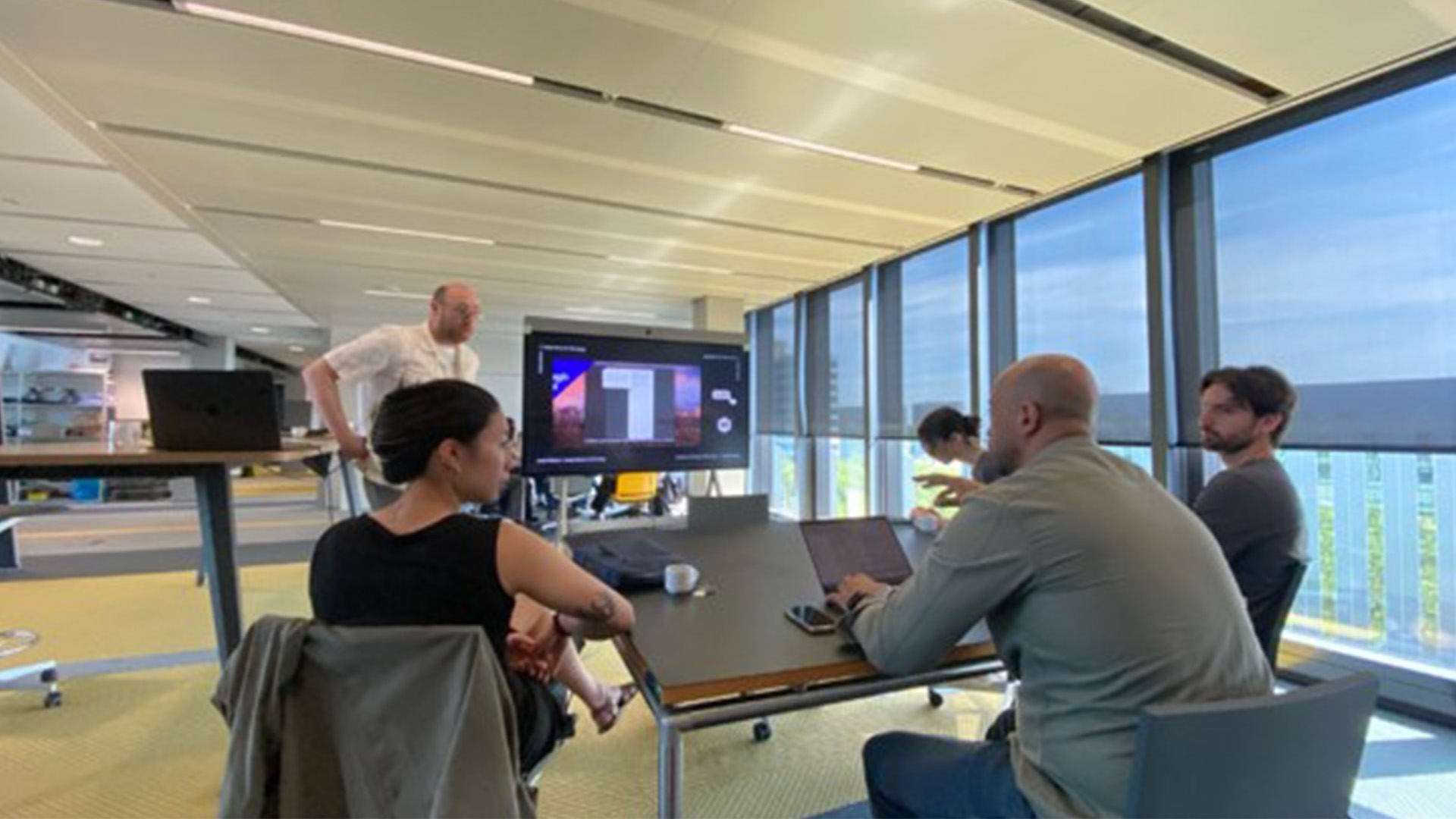
From 15 to 19 June 2026, the alignAI Doctoral Network held its third Seasonal School in Eindhoven. The five-day programme was organised by researchers and staff of Eindhoven University of Technology (TU/e), and co-hosted by TU/e and the Jheronimus Academy of Data Science (JADS). Sixteen alignAI doctoral candidates (DCs) took part, together with three principal investigators, additional researchers and staff members.
The school examined the prospects and limitations of explainability and fairness in state-of-the-art large language models (LLMs). DCs received a primer on explainable and fair AI from local experts and learned to approach the development and use of LLMs through an interdisciplinary design perspective. After theoretical and practical introductions, DCs carried out independent group work applying these concepts to the three alignAI use cases: education, mental health and news consumption. Alongside the academic programme, DCs and project PIs benefited from local sightseeing and networking opportunities. The week was led by PIs Prof. Carlos Zednik and Prof. Stephan Wensveen, together with Prof. Martijn Willemsen and Prof. Jesse Benjamin of TU/e’s Department of Industrial Design.
Day 1: Kicking Off
The summer school opened with a welcome from Professors Zednik and Wensveen, followed by a doctoral seminar in which each DC presented an update on their research since the previous Seasonal School in Copenhagen in January 2026, spanning all three alignAI use cases and eliciting considerable and constructive discussion among DCs and PIs alike. The PIs then introduced the group project that would run throughout the week, challenging the DCs, who were divided into interdisciplinary and geographically diverse teams, to apply the concepts of explainability, fairness and design to use cases in education, mental health and news consumption. The day closed with a traditional Dutch “borrel” hosted by TU/e’s Department of Industrial Design.
Day 2: Fairness
The second day was dedicated to fairness. Dr. Hilde Weerts, a TU/e expert on fairness in machine learning and developer of the FairLearn package, introduced key fairness principles, methods and technologies, and adapted them to the DCs’ own use cases and projects. DCs then applied these lessons in break-out sessions before spending the afternoon on independent group work, moderated by Prof. Willemsen.
Day 3: Explainability
On the third day, the programme moved to ‘s-Hertogenbosch and turned to explainability. Prof. Zednik introduced the notions of stakeholder dependence and the distinction between behavioural and mechanistic explainability, while Prof. Willemsen followed with a practice-focused discussion of how different stakeholders respond to different explainability methods and how to evaluate human-AI interaction and XAI techniques. The day’s academic activities were hosted by the Jheronimus Academy of Data Science, a collaboration between TU/e and Tilburg University. Prof. Willemsen, the academic director of JADS’s Data Science in Business and Entrepreneurship master’s programme, led DCs on a tour of the historic building. The afternoon continued with a boat tour of ‘s-Hertogenbosch’s historic canals and a group dinner before the return to Eindhoven.
Day 4: Design, Labs and Use-Case Workshops
Day four was organised and hosted by TU/e’s Department of Industrial Design, with a welcome from Professors Wensveen and Benjamin. The DCs toured the design spaces and labs, watched a series of student demonstrations on designing with complexity, noise and AI uncertainty, and then split into break-out workshops for each alignAI use case: education (Prof. Benjamin), mental health (Dr. Minha Lee and Ms. Joy Ciliani) and news consumption (Mr. Marijn van der Steen), testing their research insights against a designer’s perspective. In the afternoon, DCs attended a workshop on Key Enabling Methodologies (KEMs) before finalising their group presentations.
Day 5: Wrap-up
On the final day, DC groups presented the results of the week’s project. Each group addressed a common set of questions from the perspective of one of the three alignAI use cases: which fairness challenges arise within it, why and for whom explainability matters, how novel methods and design considerations could enhance both and what a well-aligned, LLM-driven application would ultimately look like.
Two groups took on education: Mr. Hewei Gao, Ms. Zeynep Kabadere and Mr. Baihong Bao focused on explainability for children aged 10 to 14, proposing gamified, tangible tools including a “red-teaming” game that builds calibrated trust rather than blind reliance; Ms. Gökce Sahin, Mr. Yung-Chen Tang, Ms. Xiaoyu Wang and Ms. Tuan Huang examined fairness in the same use case, proposing a co-created, game-based tool that builds AI literacy while staying accessible offline and to users with learning disabilities. Two further groups addressed mental health: Ms. Eva Paraschou, Ms. Simay Toplu, Mr. Cen Lu, Ms. Katerina Drakos, Ms. Julia Li and Ms. Sharvari Bondre mapped fairness risks tied to language, technology literacy and socioeconomic status, and envisioned a safety-first, evidence-grounded application that could lower barriers to care and reduce stigma. The news consumption group: Mr. Mohaned Bahr, Ms. Matilde Barbini and Mr. Stefano Sorrentino argued that fairness and explainability in AI-mediated journalism are, at heart, questions of editorial authority rather than technical properties alone, and concluded, with reference to EU law, that meaningful, early and well-resourced participation by journalists and affected communities is a precondition for genuine fairness in journalism.
The school closed with a joint reflection on the week and on the alignAI project as a whole.
Strong Marks from Participants
Feedback gathered at the end of the week was largely positive. DCs praised the content, setup and social programme, and valued having enough time both for deeper conceptual discussion with PIs and peers and for progress on the group projects. The social events were appreciated as informal networking opportunities, the fairness lecture was praised for addressing all disciplines in the cohort, and the design sessions and use-case breakout workshops were highlighted as offering valuable new perspectives. The DCs also welcomed the flexibility of the group project, which could be worked on throughout the week rather than in a single block.
What’s Next
The DCs suggested directions for future Seasonal Schools: more foundational lectures on value alignment specifically in LLMs rather than traditional predictive AI content they hope the next Seasonal School, at EPFL, might provide alongside sessions on developmental issues and a dedicated technical introduction to LLMs; input from voices outside the project (such as NGOs and governmental organisations on policy and governance), greater attention to sustainability and ethics (including the use of AI in PhD education itself), and the idea of a hackathon and of using future Seasonal Schools to rehearse upcoming conference talks. These reflections will help shape the alignAI Doctoral Network’s next Seasonal School as the cohort continues its work toward value-aligned large language models.