
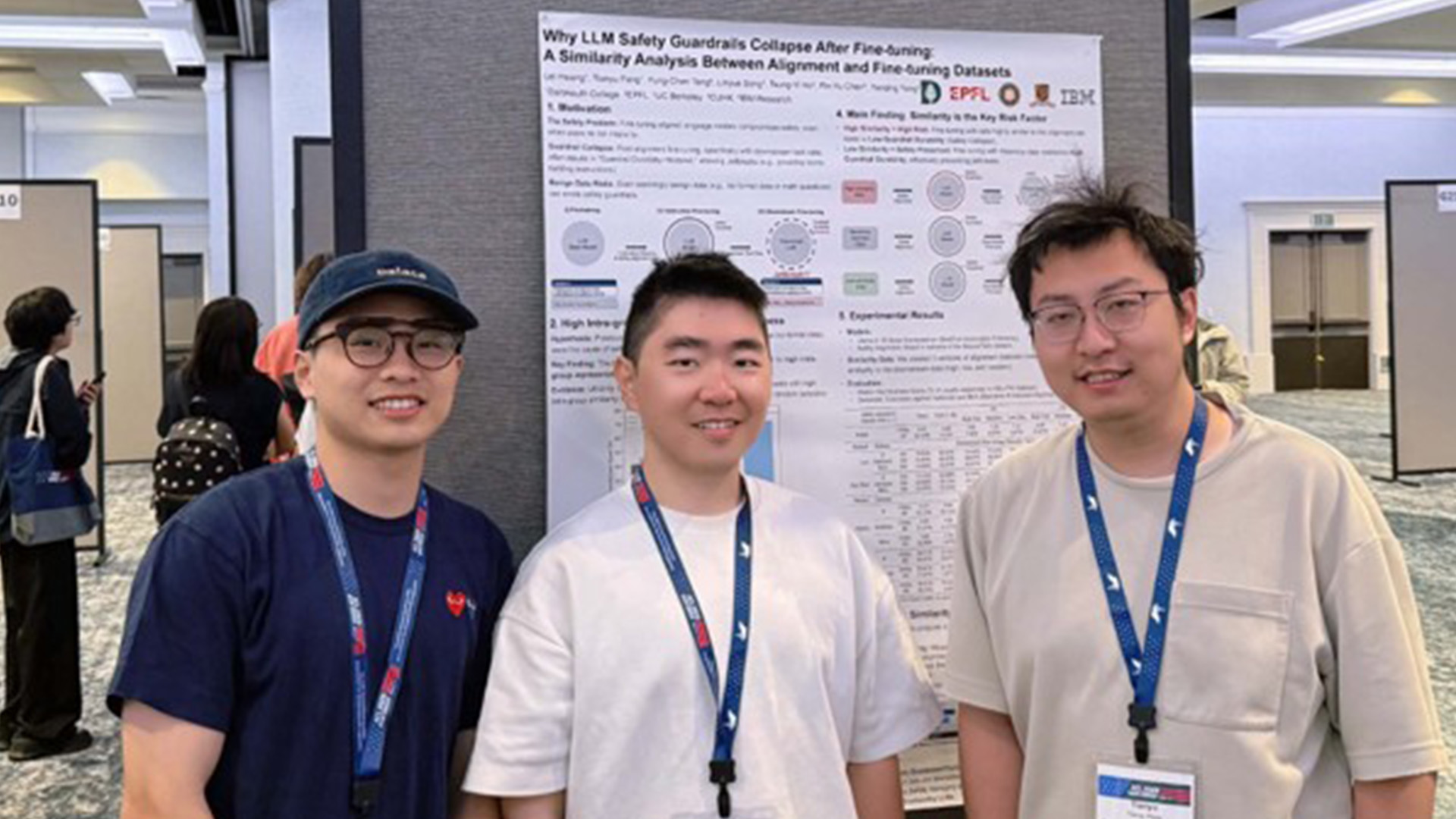
The 64th Annual Meeting of the Association for Computational Linguistics (ACL 2026) took place in San Diego from 2–7 July 2026. As one of the leading international conferences in natural language processing, ACL brought together researchers from around the world to exchange ideas on large language models, AI safety, alignment, evaluation and other emerging directions in language technologies.
alignAI Doctoral Candidate Yung-Chen Tang attended the conference and presented the paper “Why LLM Safety Guardrails Collapse After Fine-tuning: A Similarity Analysis Between Alignment and Fine-tuning Datasets”. The work investigates an important challenge in large language model safety: even after a model has undergone safety alignment, subsequent fine-tuning can weaken its original safeguards, including when the downstream training data itself is benign.
Rather than focusing only on downstream fine-tuning, the work looks further upstream and examines how the choice of safety-alignment data can affect the durability of model safety. The study finds that the relationship between alignment and fine-tuning data plays an important role in whether safety behaviour remains robust after adaptation. These findings suggest that building safer AI systems requires considering not only how models are fine-tuned, but also how safety alignment is designed in the first place.
Beyond presenting his work, attending ACL 2026 gave Mr. Tang the opportunity to exchange ideas with researchers working across AI safety, alignment, fine-tuning and model representations. These discussions also highlighted how the safety landscape is expanding beyond conventional fine-tuning. As AI systems become increasingly agentic and techniques such as reinforcement learning and model merging play larger roles in model development, new questions emerge around how safety can be preserved across different forms of learning, interaction and model composition.
As AI systems evolve rapidly, the challenge is no longer only how to make a model safe today, but how to ensure that it remains safe after learning something new.
References
Hsiung, L., Pang, T., Tang, Y.-C., Song, L., Ho, T.-Y., Chen, P.-Y., & Yang, Y. (2026). Why LLM safety guardrails collapse after fine-tuning: A similarity analysis between alignment and fine-tuning datasets. In Proceedings of the 64th Annual Meeting of the Association for Computational Linguistics (Volume 1: Long Papers) (pp. 16601–16619). Association for Computational Linguistics. https://doi.org/10.18653/v1/2026.acl-long.756.
Qi, X., Panda, A., Lyu, K., Ma, X., Roy, S., Beirami, A., Mittal, P., & Henderson, P. (2025). Safety alignment should be made more than just a few tokens deep. International Conference on Learning Representations.https://proceedings.iclr.cc/paper_files/paper/2025/hash/88be023075a5a3ff3dc3b5d26623fa22-Abstract-Conference.html.
Qi, X., Zeng, Y., Xie, T., Chen, P.-Y., Jia, R., Mittal, P., & Henderson, P. (2024). Fine-tuning aligned language models compromises safety, even when users do not intend to! International Conference on Learning Representations.https://proceedings.iclr.cc/paper_files/paper/2024/hash/83b7da3ed13f06c13ce82235c8eedf35-Abstract-Conference.html.