
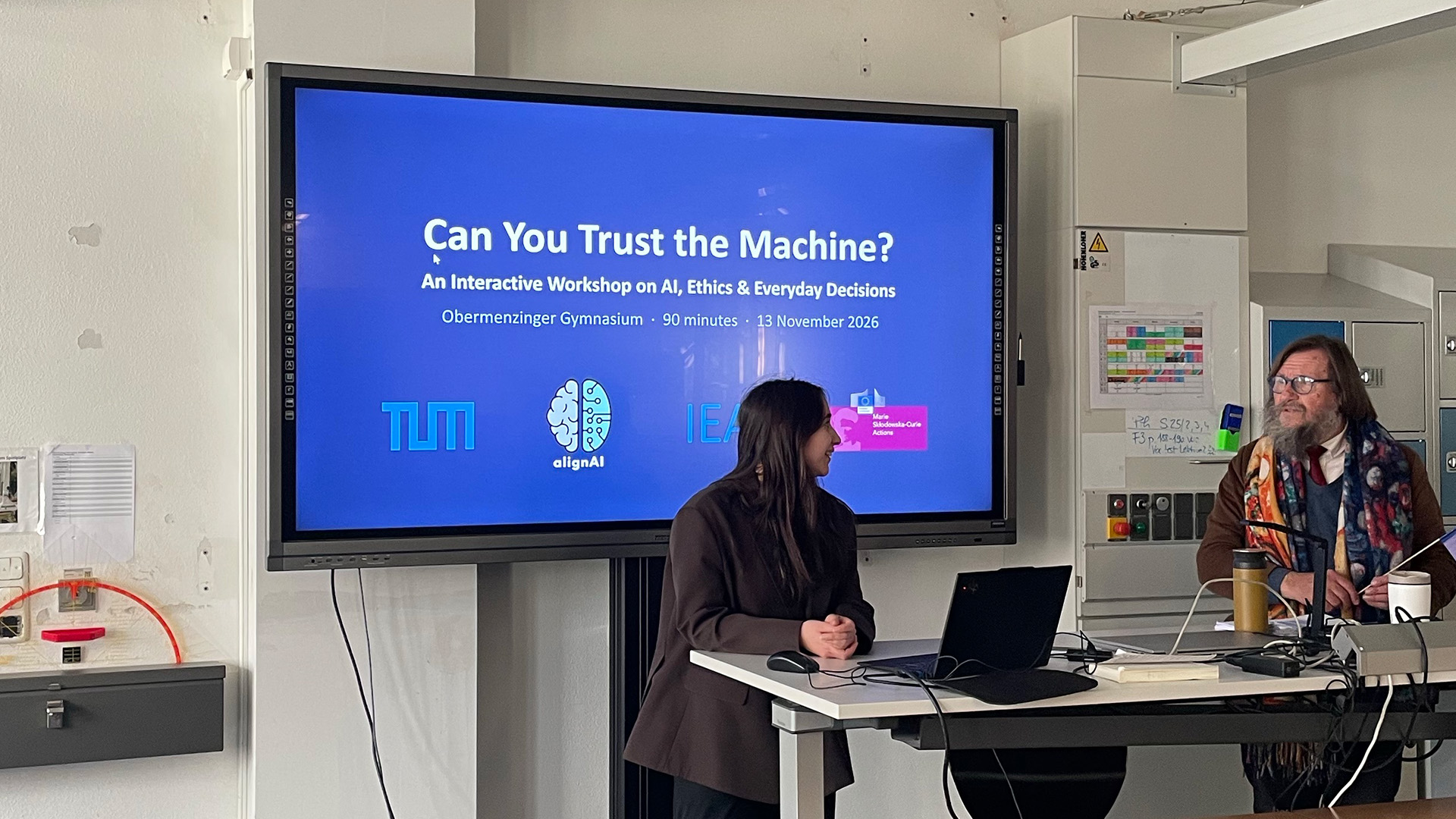
On 13 November 2026, alignAI doctoral candidates Simay Toplu and Julia Li resumed the “Can You Trust the Machine” workshop series together with Europe Direct Network. They held two back-to-back workshops with students at Obermenzinger Gymnasium, where they asked students to look critically at the AI tools they already use and to think about when and how far those tools can be trusted.
The workshop opened with an icebreaker in which students had to spot the AI-generated image. Familiar examples such as Spotify and TikTok recommendations, ChatGPT, Google Maps, video game characters and Grammarly showed how present AI already is in students’ daily lives. Next came accessible introductions about what AI is (based on the European Commission’s High-Level Expert Group definition), and how AI systems learn statistical patterns from large amounts of data. With the goal of introducing the basics of EU regulation and AI governance, students were provided an accessible description of the various risk levels of AI systems mentioned in the AI EU Act and introduced the concept of Trustworthy AI from the High Level Expert Group.
The core of this year’s workshop was a new hands-on “Sycophancy and Accuracy Exercise”. Students learned how chatbots often lead with praise, agree with users without pushing back and repeat false information they are given. At the same time, they could be used to fact-check the reliability of information if given the right instructions. Using an interactive workshop format, the students explored the effects of different prompts on the factuality, tone and length of responses on various models of chatbots in three use-cases that mirrored those in the alignAI project: Mental Health, Online News Consumption and Education. The students formed small groups to explore how chatbots would react to the following myths if given different prompts:
Scenario A: EssayHelper (Education)
Myth: Universities should stop assigning written essays because most young students in the EU use generative AI for their studies anyway.
Scenario B: ChatGPTherapy (Mental Health)
Myth: Youth should stop seeing licensed therapists and mental health clinicians and use chatbots instead.
Scenario C: BotNews (Online News Consumption)
Myth: Chatbots and AI systems (and not humans) are solely responsible for spreading fake news.
Each group reported back on what it found. In the debrief, three lessons stood out: AI can miss your errors but can also help you check facts; AI might sound equally confident whether it is right or wrong; and what you get depends on how you ask (the same AI can give different groups different answers). These lessons led to the closing question: If we can’t always trust what AI says, what should AI look like?
To answer, the workshop introduced the difference between laws and guidelines and covered the four risk levels of the EU AI Act and the seven requirements of the EU’s Guidelines on Trustworthy AI.
The overall intended learning outcomes of the workshop were:
- Increased understanding of the risks and benefits of using chatbots in real-life situations.
- Better knowledge of the effects of prompting on sycophancy and accuracy in chatbots.
- Improved awareness of EU AI regulations, norms and protections.
- Reflection on societal issues in the EU and beyond and how they impact AI use.
- Promotion of critical thinking and responsible use of technology.
- Deeper understanding of how to engage with topics about technology and ethics.
Through this workshop series, Ms. Toplu and Ms. Li continue to raise awareness of ethical use of technology and the relationship between technology, ethics and governance in the EU through formats accessible to young adults.