alignAI
Aligning LLM Technologies with Societal Values
About alignAI
About the project
The alignAI Doctoral Network will train 17 doctoral candidates (DCs) to work in the international and highly interdisciplinary field of LLM research and development. The core of the project focuses on the alignment of LLMs with human values, identifying relevant values and methods for alignment implementation. Two principles provide a foundation for the approach. First, explainability is a key enabler for all aspects of trustworthiness, accelerating development, promoting usability, and facilitating human oversight and auditing of LLMs. Second, fairness is a key aspect of trustworthiness, facilitating access to AI applications and ensuring equal impact of AI-driven decision-making. The practical relevance of the project is ensured by three use cases in education, positive mental health, and news consumption. This approach allows us to develop specific guidelines and test prototypes and tools to promote value alignment. We follow a unique methodological approach, with DCs from social sciences and humanities “twinned” with DCs from technical disciplines for each use case (9 DCs in total), while the other 8 DCs carry out horizontal research across the use cases.
About Large Language Models
Large Language Models (LLMs) are trained on broad data, using self-supervision at scale, to complete a wide range of tasks. Wider use of LLMs has risen in recent months due to applications such as ChatGPT. Although LLMs bring many opportunities to improve our everyday lives, the impacts on humans and society have not yet been prioritized or fully understood. Given the rapid development of these tools, the risk of negative implications is significant if LLMs are not developed and deployed in a way that is aligned with human values and responds to individual needs and preferences. To mitigate any negative consequences, academia, in close collaboration with industry, needs to train the next generation of researchers to understand the complexities of the socio-technical implications surrounding the use of LLMs.
Project Map
The alignAI project is built around a highly interdisciplinary training program
and research methodology designed to achieve the DN’s five research objectives:
- O1. Establish a unique doctoral training programme (i) equipping DCs with the capacity to work in interdisciplinary environments, (ii) providing high quality scientific training, (iii) equipping DCs with communication capacities and (iv) Disseminating knowledge beyond the beneficiary institutions
- O2. Identify the human values and user requirements/preferences that LLMs should align with
- O3. Explore implementable ways for applying the principles of explainability (XAI) and fairness in
the specific context of LLM use to enable alignment with values identified in RIO1 - O4. Design and build value aligned LLM prototype tools based on outcomes from RIO1 and RIO2
- O5. Test & validate the technical prototype tools from RIO3 and the non-technical
tools/methods/models from RIO1 and RIO2 - O6. Translate learnings from RIO1-RIO4 into research outputs, contextualising an “enabling
environment” for value-aligned LLMs
The doctoral training objective O1 is described in detail in Section 1.3.
The five research objectives will be addressed in a context-specific way throughout the project by
investigating them as part of three use-cases in: (i) Education, (ii) Positive Mental Health and (iii) Online
News Consumption. Fig. 3. presents the proposed research methodology. This is followed by a detailed
description of the research activities and their relevance for the project objectives.
Newsroom

Q&A with PI Line Clemmensen
In this video interview, we speak with Professor Line Clemmensen, Professor of Machine Learning at the Technical University of Denmark. She shares what her team contributes to the project, her approach to supervising PhD candidates, and how she helps them grow in both technical expertise and ethical responsibility.

Q&A with PI Sneha Das
In this video interview, we speak with Assistant Professor Sneha Das, a researcher at DTU whose work focuses on trustworthy AI and responsible data driven systems. She discusses the perspective her institute contributes to the project, and how the program can guide policy and public understanding related to AI and alignment.

Exploring AI Advancement at NeurIPS 2025
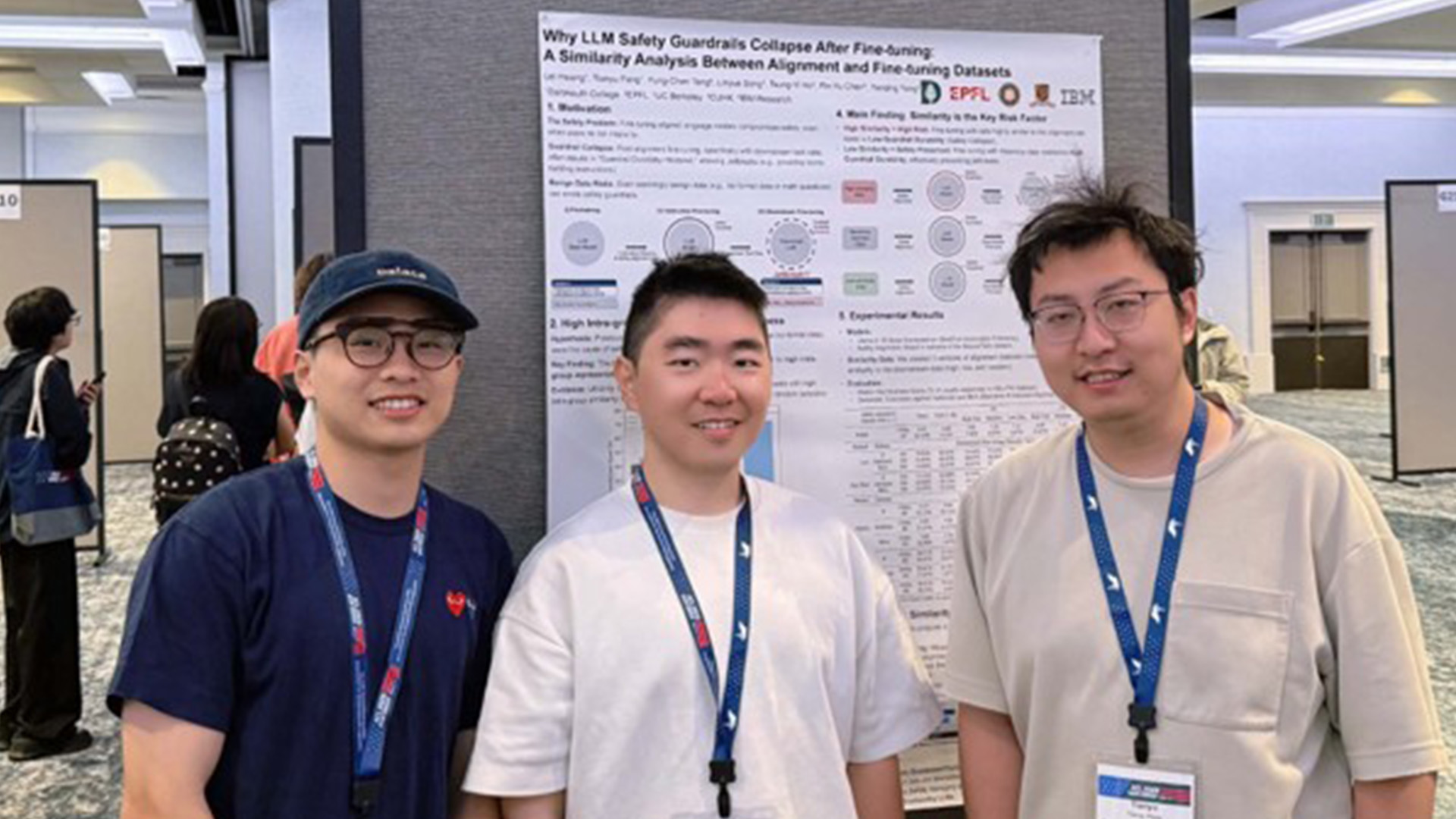
The Thirty-Ninth Annual Conference on Neural Information Processing Systems (NeurIPS 2025), was held from December 2-7 in San Diego. Our alignAI doctoral candidate Candidate Cen Lu attended and presented his poster “Chain-of-Model Learning for Language Model” at the poster session.

AI-nxiety and AI-gency: Young Adults Navigating Generative AI
As part of the TUM Institute for Ethics in Artificial Intelligence (IEAI) Speaker Series, a December 2025 session focused on young adults and generative AI. The talk, titled “AI-nxiety & AI-gency: Young Adults Navigating Generative AI” was delivered by Dr. Jaimee Stuart, Senior Researcher and Team Lead at United Nations University Macau.

Q&A with PI Martijn Willemsen
In this video interview, we speak with Professor Martijn Willemsen, a researcher at Eindhoven University of Technology known for his studies on human decision processes and recommender systems. He talks about the doctoral candidates he works with and the projects they pursue, his reasons for joining alignAI, the perspective his institute adds to the project, and the cooperation he hopes to see among partners.

Beyond Accuracy: Why “Being Right” Isn’t Enough for Human-Centred AI
Imagine the following two scenarios. A teacher asks an AI to review a student’s essay. Its feedback is accurate, the grammar is fixed and the facts are straight, yet the student still feels stuck. The student has no clue what to try next. A software team asks an AI to flag bugs. The model points to real issues, but the way it explains them leaves new engineers more confused than confident. In both cases, the tool passes the test and fails a person.
Accuracy matters, but it’s not the whole story. If we chase only the right answer, we ship systems that look strong in demos and lose people in real use.