
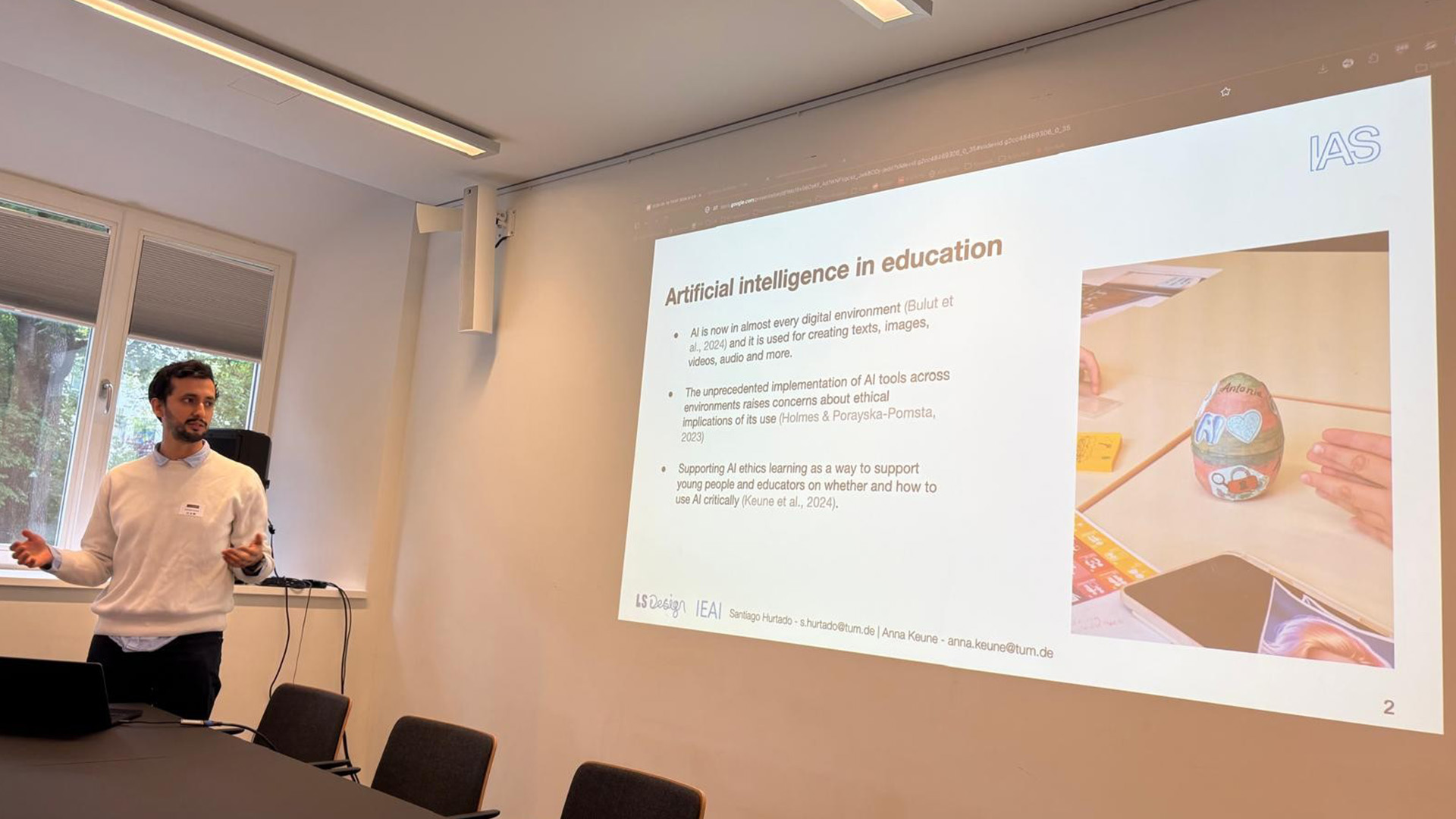
On 19–20 May 2026, Santiago Hurtado and Prof. Anna Keune from the Technical University Munich participated at The Responsible AI Forum (TRAIF) and presented their ongoing work in developing an online learning environment for AI ethics learning. The two shared their design of an online environment for youth and educators to engage with AI ethics.
Generative artificial intelligence (GenAI) is rapidly transforming educational environments, offering new possibilities for creative expression (O’Toole & Horvát, 2024; Reddy, 2022; UNESCO, 2021). However, the opacity of these systems and their potential to offload creative work raise significant concerns regarding their critical use. Youth frequently interact with these platforms without understanding how to maintain agency over their creative outputs (Khosravi et al., 2022). This research addresses the gap between abstract AI ethics principles and applied learning by proposing an educational environment which intentionally disrupts seamless automation.
Current AI literacy frameworks often prioritise functional mechanics over tangible ethical applications, leaving concepts like the OECD AI principles abstract and difficult to implement (Touretzky et al., 2023). Furthermore, AI’s ability to rapidly generate content can encourage overreliance, diminishing human-generated outputs and overall creative agency (Doshi & Hauser, 2024). Constructionist learning theory is used in the pair’s study, which posits learners develop a deeper understanding of abstract concepts by creating personally meaningful, shareable artifacts (Holbert et al., 2020; Papert, 1980). By integrating tangible craft materials with digital AI systems, they aimed to slow down the creative process, making the ethical dimensions of AI visible and open to critique.
This study utilised a Research-Based Design (RBD) approach, which integrates the design process as an essential component of the research itself (Leinonen et al., 2008). The methodology spanned four iterative phases. First, through contextual inquiry, they utilised AI ethics scenarios and conducted expert interviews to establish initial problem contexts and design challenges. Second, in the participatory design phase, the team conducted interventions with 50 young people across school and out-of-school settings, alongside 12 co-design sessions with 55 educators to test early prototypes. Third, product design involved iteratively refining concrete use cases, resulting in the development of seven arts-based, tangible-digital activities and an interactive online learning environment. Finally, treating the design as a hypothesis, a functioning prototype was developed as a testable artifact in authentic educational settings, hypothesising that tangible-digital artwork cycles foster deeper critical questioning.
The RBD process yielded a suite of tangible-digital activities embedded within a comprehensive online learning platform designed to facilitate critical AI use. Activities such as “Magazine cut-outs” and “Expanded frames” require learners to continuously move between physical crafting and digital AI generation. This process inherently slows down AI generation, creating specific moments for learners to evaluate how AI shapes their work. Findings indicate that ethical reflection emerged most strongly when AI disrupted creative intentions. When the AI introduced unexpected elements or failed to interpret multimodal inputs accurately, learners actively critiqued the outputs and negotiated their own agency in the design process. To support this, the resulting online learning environment integrates instructional guides, embedded AI features and image history tracking to aid educators in facilitating complex, tangible-digital design cycles without needing external tools.
The team’s ongoing work with the design of learning environments and tools for AI ethics underscores the necessity of designing learning environments that prioritise friction, iteration and material engagement over seamless AI automation. By framing AI as a co-creator whose contributions require ongoing interpretation, learners are positioned as active decision-makers. Slower, tangible interaction with generative AI transforms abstract ethical concepts, such as transparency and authorship, into situated, practice-based understanding. Ultimately, to support critical AI literacy, educational designs must focus on making the creative process visible, ensuring that AI systems augment rather than replace human creative agency.
References
Doshi, A. R., & Hauser, O. P. (2024). Generative AI enhances individual creativity but reduces the collective diversity of novel content. Science Advances, 10(28), eadn5290. https://doi.org/10.1126/sciadv.adn5290.
Holbert, N., Berland, M., & Kafai, Y. B. (Eds.). (2020). Designing constructionist futures: The art, theory, and practice of learning designs. The MIT Press.
Khosravi, H., Shum, S. B., Chen, G., Conati, C., Tsai, Y.-S., Kay, J., Knight, S., Martinez-Maldonado, R., Sadiq, S., & Gašević, D. (2022). Explainable Artificial Intelligence in education. Computers and Education: Artificial Intelligence, 3, 100074. https://doi.org/10.1016/j.caeai.2022.100074.
Leinonen, T., Toikkanen, T., & Silfvast, K. (2008). Software as hypothesis: Research-based design methodology. Proceedings of the Tenth Anniversary Conference on Participatory Design 2008, 61-70.
O’Toole, K., & Horvát, E.-Á. (2024). Extending human creativity with AI. Journal of Creativity, 34(2), 100080. https://doi.org/10.1016/j.yjoc.2024.100080.
Papert, S. (1980). Mindstorms: Children, computers, and powerful ideas. Basic Books.
Reddy, A. (2022). Artificial everyday creativity: Creative leaps with AI through critical making. Digital Creativity, 33(4), 295-313. https://doi.org/10.1080/14626268.2022.2138452.
Touretzky, D., Gardner-McCune, C., & Seehorn, D. (2023). Machine learning and the five big ideas in AI. International Journal of Artificial Intelligence in Education, 33(2), 233-266. https://doi.org/10.1007/s40593-022-00314-1.
UNESCO. (2021). AI and education: Guidance for policy-makers. UNESCO. https://doi.org/10.54675/PCSP7350.