
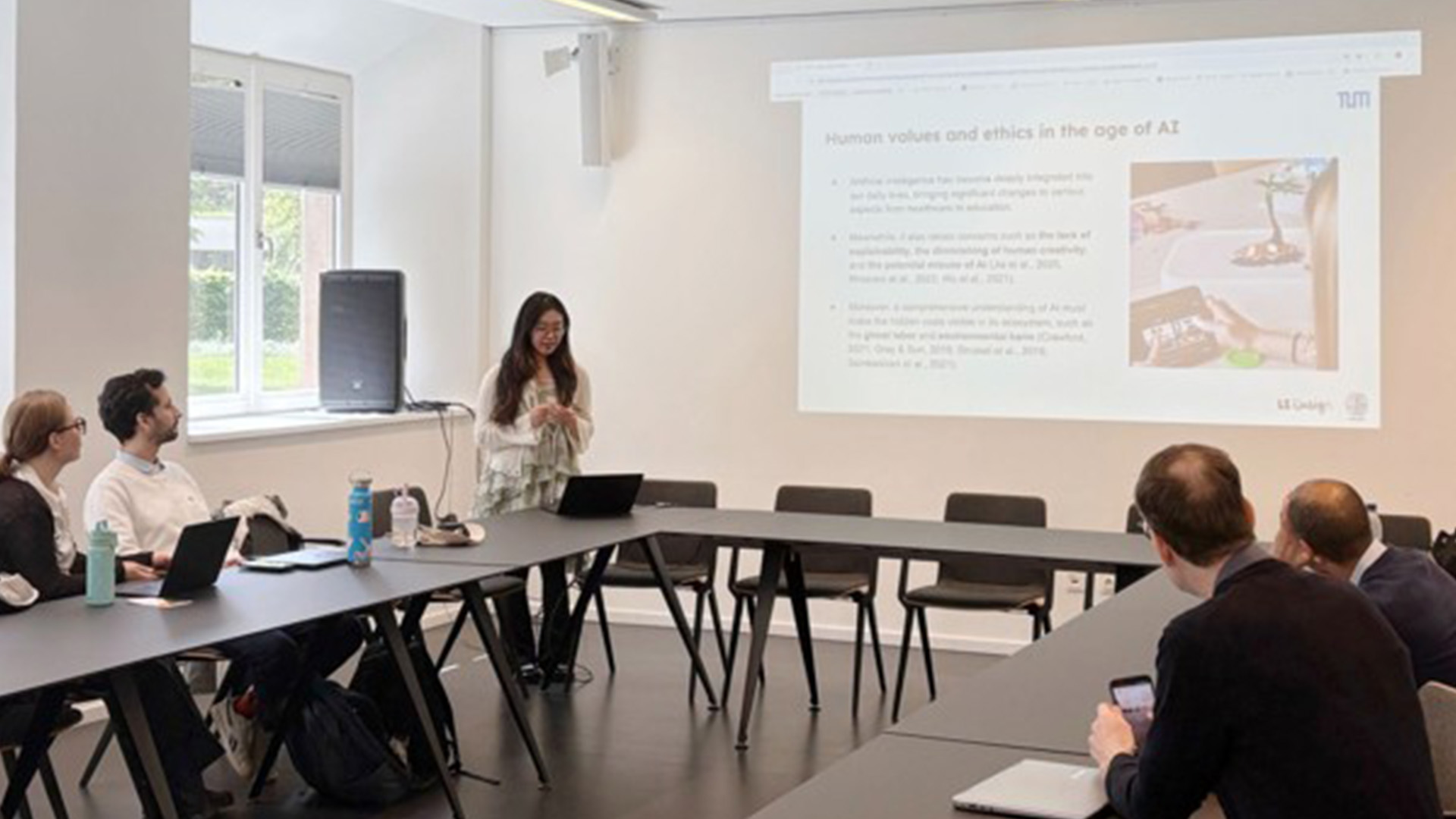
The Responsible AI Forum (TRAIF) 2026 took place at Amerikahaus in Munich on 19–20 May 2026, bringing together researchers, educators, policymakers and practitioners to discuss how AI can be developed and used responsibly. Across the two days, the forum created space for conversations on public interest, accountability, education, creativity and the practical challenges of aligning AI with human values.
At TRAIF, alignAI doctoral candidate Xiaoyu Wang from the Technical University of Munich presented her work, supervised by Prof. Anna Keune, titled “Design for Critical AI Use and Creativity among Young People through Human-AI Co-Creative Making”. The presentation explored how learning activities that combine tangible materials and digital AI tools can support young people in developing creativity, explainability and critical AI use.
The work responds to growing concerns around AI explainability, the possible diminishing of human creativity and the misuse of AI in everyday contexts (Jia et al., 2025; Khosravi et al., 2022; Wu et al., 2021). Drawing on constructionist learning (Papert, 1980; Papert & Solomon, 1971), the study designed six human-AI co-create activities and invited youth to make personally meaningful artifacts while interacting with AI tools. One activity asked whether AI was better at generating design drawings or circuit diagrams. While AI-generated images often inspired creative design, AI-generated circuit diagrams appeared convincing but were technically incorrect. These moments opened up discussions about how AI systems generate visuals, why they make mistakes and why users need to question AI rather than simply trust it. The work highlighted how integrating tangible and digital interactions can turn AI ethics from an abstract topic into something youth can experience, test and reflect on directly and critically (Long & Magerko, 2020; Keune et al., 2024).
A major conference highlight was the Panel on AI and Education, moderated by Prof. Nicole Lønfeldt, with Prof. Christiane Lütge, Prof. Anna Keune and Prof. Sneha Das. The discussion addressed how AI is reshaping creativity, learning and the roles of both students and educators. Panelists reflected on AI as a collaborator in creative work, but also on the anxieties it may create: students may worry about assessment, future careers and which skills will remain valuable, while teachers face uncertainty about how their roles may change. The panel emphasised the importance of educator AI literacy, realistic goals for what teachers need to know about AI, and the need to rethink evaluation, curriculum design and student-teacher collaboration in light of rapidly changing technologies.
Together, these discussions connected strongly with the presentation’s focus on critical AI use. Whether in classrooms, creative workshops or public institutions, responsible AI depends not only on technical systems, but also on people’s ability to question, understand and shape how AI is used. TRAIF 2026 was therefore an inspiring opportunity to situate youth AI ethics education within broader topics on accountability, responsibility, creativity and value alignment.
References
Jia, Y., Chang, M., & Wang, F. (2025). The double-edged sword of GenAI in K-12 education: A systematic review of cognitive offloading risks. Computers & Education, 226, 105120.
Keune, A., Peppler, K., & Wohlwend, K. (2024). Creative materialities: Crafting and learning with generative media in youth studio spaces. Thinking Skills and Creativity, 52, 101511.
Khosravi, H., Shum, S. B., Poquet, O., & Conati, C. (2022). Explainable AI in education: From principles to practices. Computers and Education: Artificial Intelligence, 3, 100054.
Long, D., & Magerko, B. (2020). What is AI literacy? Competencies and design considerations. Proceedings of the 2020 CHI Conference on Human Factors in Computing Systems, 1–16.
Papert, S. (1980). Mindstorms: Children, computers, and powerful ideas. Basic Books.
Papert, S., & Solomon, C. (1971). Twenty things to do with a computer (Artificial Intelligence Memo No. 248). Massachusetts Institute of Technology, Artificial Intelligence Laboratory.
Wu, X., Xiao, L., & Wang, Y. (2021). Deconstructing the black box: A review of explainable artificial intelligence in everyday contexts. International Journal of Human–Computer Interaction, 37(14), 1301–1315.